
Artificial intelligence is transforming the banking and financial sector at breakneck speed, bringing innovations that revolutionize the way institutions manage their operations and interact with their customers. But beyond the technological promises, what are the real applications that make the difference? Discover in this article how generative AI is revolutionizing the banking and financial sector by providing innovative solutions and new perspectives.
Generative AI adoption statistics in banking and finance
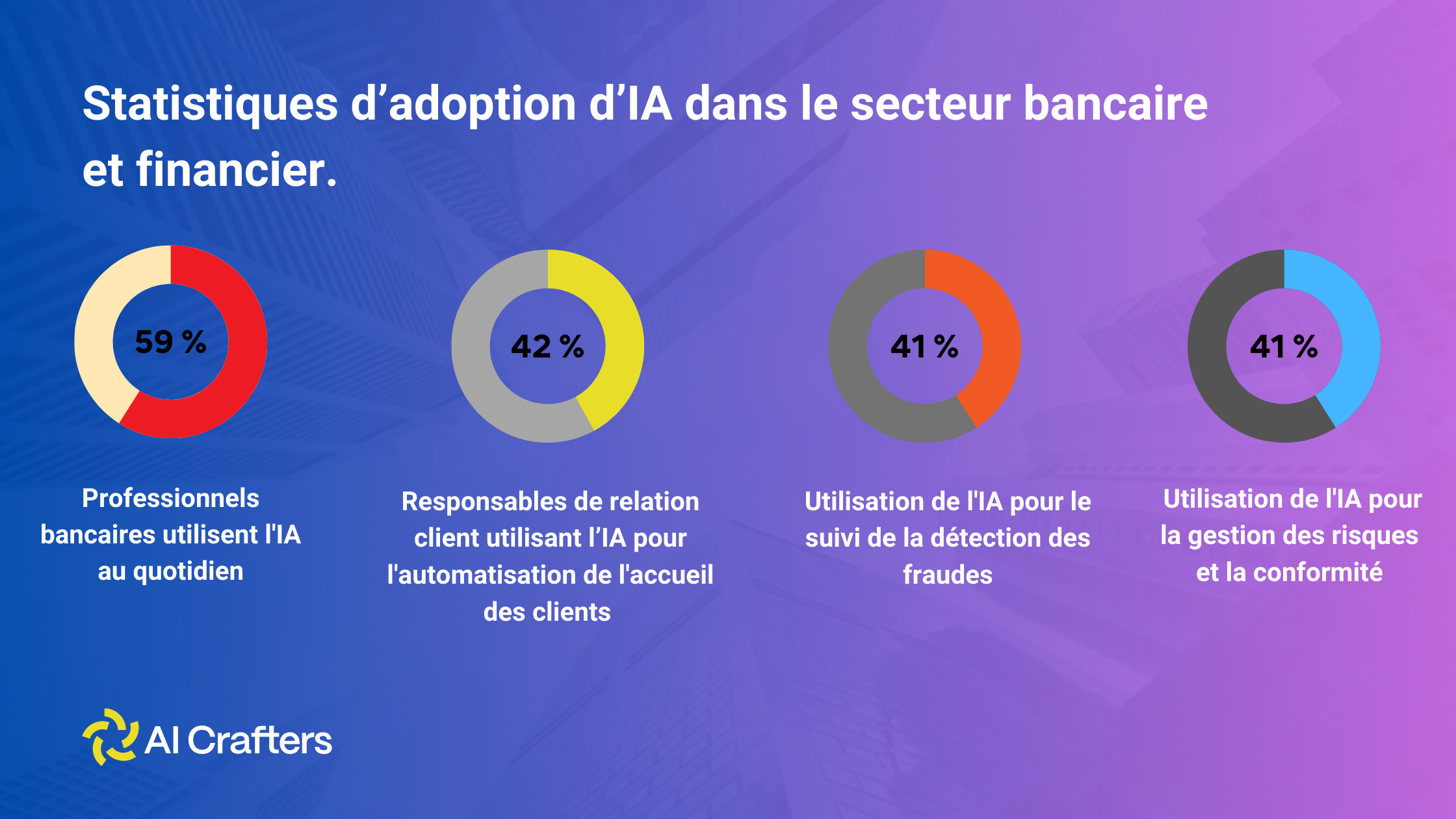
The adoption of generative AI is transforming the banking and financial sector. According to an Avanade study, 59% of professionals use it daily. The survey also reveals that 85% of IT leaders are developing clear strategies for integrating AI into the development of new products and services. Furthermore, 24% of financial experts consider AI as a lever for making more informed decisions. Key applications, such as customer onboarding automation (42%), fraud detection (41%) and risk management (41%), demonstrate this commitment to increased efficiency and personalisation of services.
The uses of generative AI in banking and finance.
-
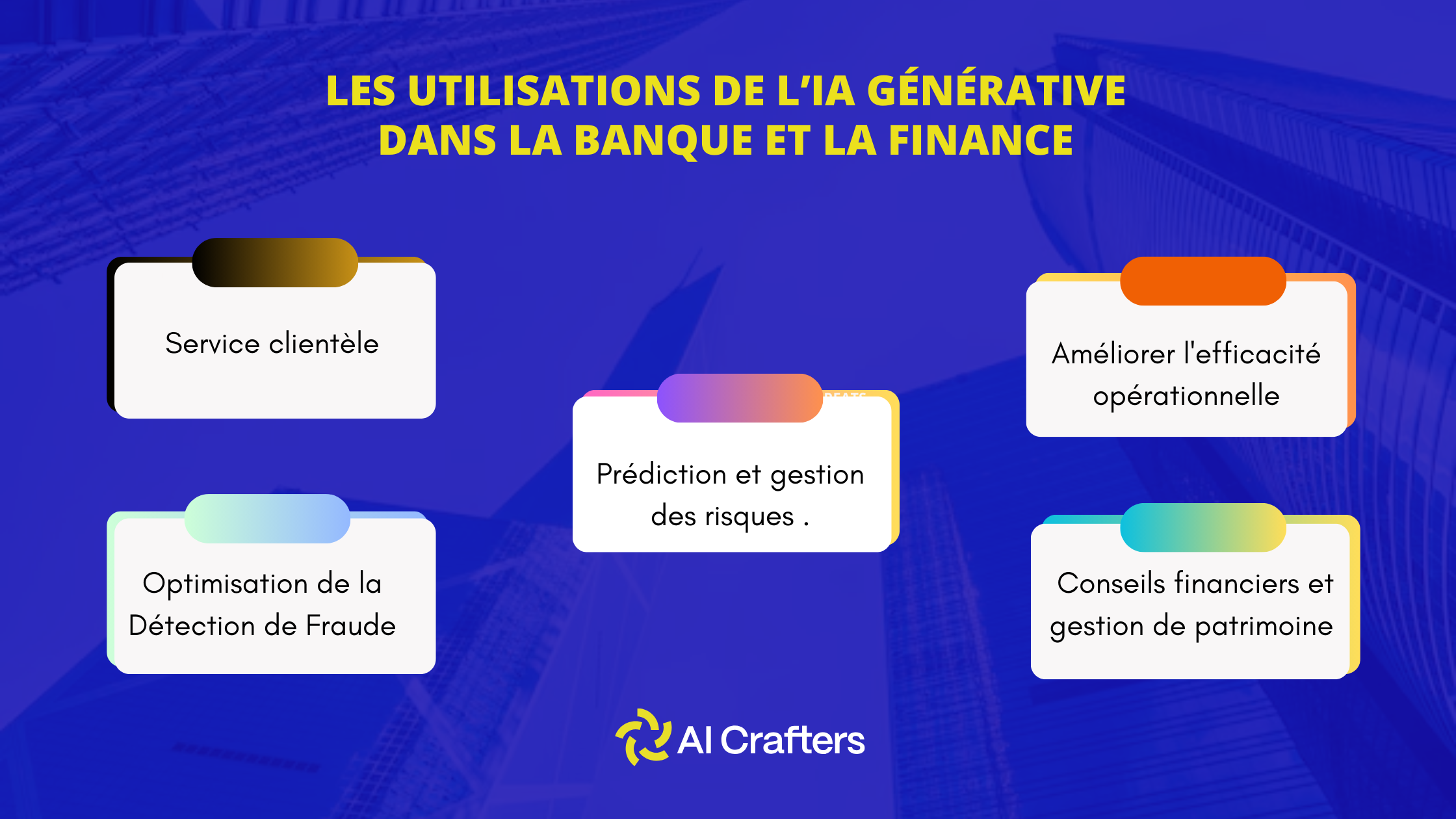
- Personalisation of customer services in real time
Banks and insurance companies quickly understood the advantage of chatbots to improve the customer experience. AI makes interactions smoother, provides instant responses and proactively anticipates needs. Take the example of Erica, the virtual assistant from Bank of America. It helps customers manage their finances, predict future expenses and make payments, offering a service available 24/7. The use of customer chatbots in the banking and financial sectors brings added value on a daily basis by simplifying financial management, ensuring constant availability and offering personalised advice to customers.
-
- Fraud detection optimisation
Bank fraud is a major challenge, but AI offers a revolutionary solution. Faced with constantly evolving threats, traditional detection systems are no longer enough. Using AI, machine learning algorithms can analyse millions of transactions in real time, identify unusual behaviour and act immediately. For example, JP Morgan Chase uses AI to monitor transactions in real time and detect anomalies with unparalleled accuracy, surpassing human capabilities. This proactive technology enhances security, protects financial assets and inspires increased customer confidence.
-
- Risk prediction and management
AI has become essential to help financial institutions predict market trends and assess investment risks. By analysing vast quantities of data from various sources such as economic events, market trends, customer behaviour, AI detects weak signals that could escape human analysts. For example, Goldman Sachs uses AI to anticipate market fluctuations and refine its forecasts. Thanks to AI, this institution can not only minimize financial risks, but also optimise returns in a more precise and personalised way.
-
- Improve operational efficiency
AI plays an essential role in the automation of internal processes, particularly through Robotic Process Automation (RPA). These technologies help transform repetitive and time-consuming tasks into smooth and automated processes, significantly reducing the time and effort required. Deutsche Bank, for example, uses AI-powered RPA solutions to automate operations such as customer forms management, data verification and reporting, freeing their teams from tedious administrative burdens to focus on higher value missions.
-
- Financial advice and wealth management
Generative AI is revolutionizing wealth management by personalizing financial recommendations at scale. Thanks to its intelligent processing of customer data, it creates simulations of investment scenarios based on individual objectives, anticipating economic trends. For example, Wealthfront, a leader in wealth management, uses advanced algorithms to generate tailored strategies, guiding its clients toward optimised investments while providing an intuitive and predictive experience.
Generative AI use cases in banking and finance
-
- Mastercard
Mastercard uses generative AI through its “Decision Intelligence” solution to detect fraud by analysing billions of transactions in real time. This solution makes it possible to identify complex fraudulent schemes and double the speed of detection of compromised cards. With rapid analysis of anomalies, banks are alerted more effectively, reducing false positives and minimizing disruption for customers.
-
- Morgan Stanley
Morgan Stanley uses the 'Debrief' tool, powered by generative AI, to produce personalised reports that summarize important meetings and discussions. This tool allows financial advisors to quickly access key information and tailor their advice to clients’ specific needs. Debrief uses generative AI to transform complex data into clear insights, facilitating communication between advisors and clients, thereby strengthening the relationship with investors.
-
- CitiBank
Citibank collaborates with Feedzai to integrate generative AI into fraud prevention and risk management. The Feedzai tool uses advanced algorithms to monitor transactions in real time, detect anomalies and generate relevant alerts. Using generative AI, Feedzai transforms massive volumes of data into actionable insights, enabling Citibank to make fast, accurate decisions to secure transactions and improve customer experiences.
-
- BlackRok
BlackRock has launched Aladdin Copilot, an investment management solution integrating generative AI to revolutionize the user experience. Aladdin Copilot helps navigate complex decisions, providing instant analytics, personalised recommendations and intelligent automation, all designed to make portfolio management more intuitive and efficient. Through its integration with Microsoft technologies, this solution combines the power of machine learning and real-time insights, allowing investors to act with precision and confidence.
Conclusion
Generative AI is transforming the future of finance by reinventing services to make them more fluid, secure and user-centric. By transforming every interaction, from customer relations to risk management, AI opens new perspectives for more agile and connected services. This innovation is not a simple technological advance, but a real paradigm shift that reinvents the standards of the financial sector.
← All articles