
AI is today at the heart of technological innovation. Choosing the right AI language model and API provider can be critical to the success of many businesses. With a multitude of options available, it is crucial to understand the differences in performance, cost and capacity of various models and suppliers. This article provides an in-depth comparative analysis of leading AI language models and API providers. Our goal is to provide you with the information you need to make informed decisions and optimise your AI investments.
1- AI language model
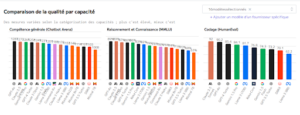
When it comes to comparing AI language models, there are several criteria to consider. Among them, general competence, reasoning, knowledge, and coding ability are essential measures for evaluating performance.
General Skill (Chatbot Arena): This criterion evaluates the models' ability to lead natural and engaging conversations.
Reasoning and Knowledge (MMLU): here, we measure the models' ability to process complex information and demonstrate a deep understanding of varied topics.
Coding (HumanEVAL): This metric assesses the ability of models to generate quality code that is useful for developers and technical applications.
Each use case may require specific evaluation tests. For example, Chatbot Arena is ideal for assessing communication skills, while MMLU is more suitable for testing reasoning and knowledge.
Quality vs. Output speed
AI language models vary not only in quality, but also in output speed. Here is a comparison of the main models:
GPT-4 and GPT-4 Turbo: These models are known for their high quality, they offer superior performance in terms of reasoning and text generation, but with moderate output speed.
Gemini 1.5 Pro and Flash Gemini 1.5: these models are balanced, offering a good combination of quality and speed.
Lama 3 (70B) and (8B): these models are distinguished by high output speed, but with variations in terms of quality.
Mixtral 8x22B and 8x7B: these models offer stable performance, although they are more expensive.
Mistral 7B and Claude 3.5 Sonnet: newer models with good value for money.
Haiku Claude 3 and Command-R+: These models are positioned in an intermediate range, offering reasonable performance at moderate costs.
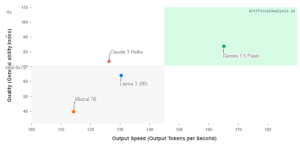
A trade-off often exists between quality and output speed, with higher quality models generally having a lower output speed.
Quality vs. Price
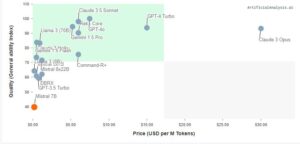
The cost of AI models is a crucial factor for businesses. Prices can vary significantly, particularly between entry and exit token prices. For example:
Entrance price: The cost per token included in the request sent to the API.
Release price: The cost per token generated by the model.
The choice of model must take into account the quality/price ratio, by evaluating the average relative performance and the cost per million tokens.
Pricing: entry and exit prices
Prices vary significantly between entry and exit tokens, with price gaps reaching more than 10x between the most expensive and cheapest models.
Entrance price: Cost per token included in the request or message sent to the API, represented in USD per million tokens.
Release price: Cost per token generated by the model, represented in USD per million tokens.
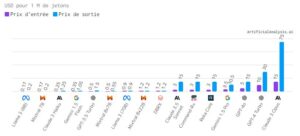
These price variations should be carefully evaluated based on the specific use case to optimise overall costs.
2- Strengths of API providers
Comparison of API Providers
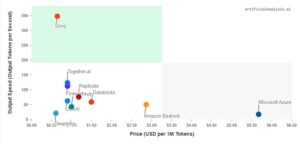
API providers play a critical role in the overall performance of AI models. Here is a comparison of the top API providers in terms of output speed and price:
Microsoft Azure and Amazon Bedrock: These cloud giants offer robust solutions with competitive output speeds, but often at a high cost.
Groq and Ensemble.ai: Emerging vendors offering high output speeds and competitive pricing.
Perplexity and Deepinfra: these suppliers stand out for their attractive prices and good performance.
Reproducible and DataBricks: Offering reliable solutions with a good balance between speed and cost.
OctoAI and Fireworks: ideal for businesses seeking cost-effective alternatives with respectable performance.
Output speed vs. price
Output speed is a determining factor for many real-time applications. Smaller, emerging providers like Groq and Ensemble.ai often offer high output speeds at more competitive prices than large, established providers. The Llama 3 Instruct (70B) model particularly stands out for its attractive price/quality ratio.
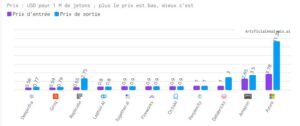
Pricing (Entry and Exit Price): Llama 3 Instruct (70B)
For the Llama 3 Instruct (70B) model, entry and exit prices are also competitive:
Entrance price: USD per million tokens, the lower the price, the better.
Release price: USD per million tokens, providers typically charge different prices for entry and exit tokens.
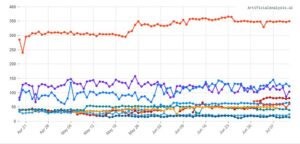
Output speed, over time: Llama 3 Instruct (70B)
Output speed is measured in tokens per second received while the model generates tokens. For the Llama 3 Instruct (70B), performance is consistent, but may vary slightly over time:
Output speed: Measured in tokens per second.
Measurement over time: based on a median measurement per day, taking into account multiple daily samples to ensure accuracy.
Smaller and emerging providers offer high output speeds, although the precise speeds provided vary from day to day.
Choosing the right AI language model and API provider requires careful analysis of the specific application needs, model performance, and associated costs. This comparative analysis highlights the strengths and trade-offs of each option, helping you make decisions to optimise your AI investments. By considering criteria such as quality, output speed, and cost, you can select solutions that provide the best value for your specific use cases.
← All articles