
The rapid evolution of generative artificial intelligence is now redefining the project management landscape, revealing a horizon of captivating possibilities for project managers. This innovative technology not only reinvents their working methods, but it also opens the doors to limitless efficiency and creativity. In this article, we explore how generative AI is transforming project management practices, while paving the way for more dynamic and adaptive strategies.
The applications of generative AI in project management
Generative AI has today established itself as an essential tool for professionals, particularly in the field of project management. The adoption of this technology by project managers leads to a notable qualitative improvement in their work and a significant increase in productivity. It considerably enriches their processes and results, thus marking a decisive turning point in efficiency and innovation in project management.
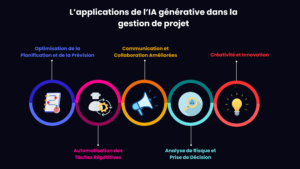
- Optimisation of Planning and Forecasting
Generative AI improves project management planning and forecasting by leveraging machine learning algorithms to analyse historical and current data, identifying trends and predictive patterns. This allows for a more accurate assessment of time, costs and risks. For example, in the construction industry, a project manager's use of AI to review data from past projects can accurately estimate material and labor requirements, reducing cost overruns and delays. By anticipating potential issues and adapting plans accordingly, project managers are better equipped to make informed decisions and respond proactively to unforeseen challenges.
- Automation of Repetitive Tasks
Generative AI frees project managers from time-consuming operations, allowing increased focus on strategic aspects. For example, in the events industry, project managers can use AI to automate the planning of routine tasks like updating event calendars or communicating with suppliers. This automation reduces human errors, speeds up processes and optimizes the overall organisation, giving project managers more time to focus on creativity and innovation in their events.
- Improved Communication and Collaboration
Generative AI improves communication and collaboration in project management by facilitating information exchange and coordination between teams. For example, in the technology sector, project managers can use AI tools to automatically translate communications between multilingual teams, ensuring clear understanding and effective collaboration. AI can also analyse project communications to identify potential issues or friction points, enabling rapid intervention and proactive conflict resolution, leading to better team harmony and efficiency.
- Risk Analysis and Decision Making
In project management, generative AI is radically transforming risk analysis and decision-making. With its ability to process and analyse large data sets, AI can predict potential problems well before they become critical. It allows project managers to identify patterns and trends that could indicate future risks, such as delivery delays or budget overruns. For example, in IT project management, AI can analyse past project performance to predict completion times for different phases, enabling more strategic resource allocation and more precise planning. This proactive approach through AI helps project managers make informed decisions, reduce risks and ensure smoother and more successful project execution.
- Creativity and Innovation thanks to AI
The revolution of creativity and innovation in project management has become a striking reality with the emergence of generative AI. This technology offers innovative and stimulating perspectives, propelling project managers beyond conventional methods. In the field of industrial design, for example, AI has the capacity to automatically generate a multitude of design concepts based on specific criteria, thus injecting dynamism and diversity into brainstorming sessions. This method opens the way to previously unexplored horizons of innovation, where rapid experimentation and visualization of various solutions encourage the discovery of revolutionary strategies and optimal solutions.
AI tools for project managers
AI concept
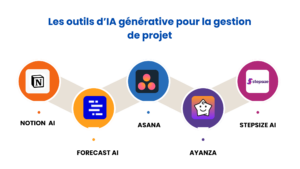
Description: Notion AI is an all-in-one project management and note-taking platform that uses artificial intelligence to improve organisation, collaboration, and workflow management. It offers advanced capabilities such as automatic content creation, intelligent data organisation and seamless integration of various work tools.
Use case: A project manager can use Notion AI to centralize and automate project documentation, creating interactive roadmaps and dynamic dashboards that update in real time with the team's progress. This approach allows a clear vision of the progress of the project and facilitates decision-making based on up-to-date data.
Forecast AI
Description: Forecast AI is an advanced project management tool that uses artificial intelligence to predict deadlines and optimise resource planning, providing increased visibility and accuracy in managing project deadlines. Its AI-based analysis helps anticipate delays and improve decision-making.
Use case: The project manager uses Forecast AI to automatically estimate the duration of different phases of a project, based on historical data, allowing them to create a realistic schedule and anticipate resource needs. This predictive analysis helps minimize delays and optimise resource allocation throughout the project.
Stepsize AI
Description: Stepsize AI is an AI tool that automatically analyzes project data to create intuitive reports, providing daily updates on team progress and complete visibility, while providing strong security and granular access controls. It replaces manual updates with automatic summaries, facilitating coordination and communication within teams.
Use case: Imagine a digital marketing project manager using Stepsize AI to analyse marketing campaign data. This tool allows them to quickly identify trends, issues and opportunities, making it easier to optimise strategies in real time and improve their team's collaboration and productivity.
Asana
Description: Asana is an online project management platform with AI-powered features that make it easier to collaborate and track tasks across teams. It aims to improve productivity by allowing users to create, organise and track projects seamlessly.
Use case: Asana can, for example, be used by the software development project manager to organise development stages, assign tasks to developers, and track bugs, making it easier to manage complex projects and accelerate the delivery of high-quality products.
Ayanza
Description: Ayanza is an AI-powered project management software, offering a user-friendly interface, AI suggestions for project optimisation, and collaboration centralization for effective team coordination.
Use case: For example, imagine an interior design project manager uses Ayanza to receive AI suggestions on material, colour and layout choices, in order to optimise project design. This tool gives him innovative and creative ideas, which allows him to improve his design process, thereby increasing the efficiency of planning and creation.
Conclusion
The integration of generative AI into project management marks a watershed moment, propelling the sector towards an era of unprecedented innovation and efficiency. This progress transcends conventional methods, paving the way for remarkable collaboration between human and artificial intelligence, thus creating projects that stand out for their dynamism, intuitiveness and exceptional success. More than just a technological fusion, it radically redefines the potential of project management, inviting us to boldly rethink our collective capabilities and the infinite horizons of what we can achieve together.
← All articles