
Mastering new skills has become an essential challenge to remain efficient in the face of changes in the world of work. Artificial intelligence is redesigning professional training by offering ultra-personalised and adaptive solutions. It not only accelerates learning, but also enriches it through immersive and interactive methods. Visionary companies integrate it to strengthen the skills of their teams and adapt to market demands. This article explores how AI is transforming training and propelling the professional development of employees.
Business AI adoption statistics
The integration of artificial intelligence (AI) into corporate training programmes has become a major strategic issue for maintaining competitiveness and promoting innovation. According to a study carried out in 2024, published by Learn Things, 76% of companies believe that AI training is essential to remain competitive, but only 10% of employees have received adequate training. This disparity highlights an urgent need to invest in developing AI skills within organisations. Furthermore, 38.5% of companies using AI have already trained their current employees, demonstrating a growing recognition of the importance of skills adaptation. AI training programmes have a notable impact on business performance; 50% of those who adopted AI report a 20% increase in their productivity. Additionally, 70% of companies that have implemented training programmes see an improvement in employee productivity, while 65% of trained employees feel more confident in using these technologies. However, obstacles remain, notably the lack of financial resources, cited by 42% of companies, and the lack of time, mentioned by 35% of managers, hindering the implementation of AI training programmes. Despite these challenges, the commitment to AI training is clear; 60% of companies have already implemented dedicated programmes, and 20% plan to increase their investments in AI training over the next 12 months. These statistics illustrate the transformation underway in the professional landscape, where AI plays a central role in the evolution of skills and organisational performance.
Source: www.learnthings.fr
Using AI to develop your own skills
- Training adapted to each employee
AI is revolutionizing training by precisely adapting to the individual needs of employees. By continuously analysing their performance, interactions and learning pace, adaptive platforms dynamically adjust content, ensuring optimal knowledge assimilation. At IBM, for example, Watson AI personalizes training courses by recommending specific modules based on identified gaps and professional objectives. This approach allowed an increase in knowledge retention and a significant reduction in learning time. Employees thus gain skills in a more efficient and targeted manner, strengthening their adaptability to market demands.
- AI as a teaching assistant
Chatbots and virtual assistants integrated into training platforms allow learners to get instant answers, interact with relevant content and deepen their knowledge independently. AI is not limited to providing static explanations, it adapts its support according to the user's level and context. Take PwC for example, ChatGPT is used as a virtual assistant to support employees in their training and daily work. Through its integration into internal systems, employees can ask technical questions, get explanations of complex concepts, and receive suggestions to optimise their analyzes and reports. This initiative improved productivity and reduced time spent searching for information, allowing teams to focus more on high-value tasks.
- Immersive simulation and learning by doing
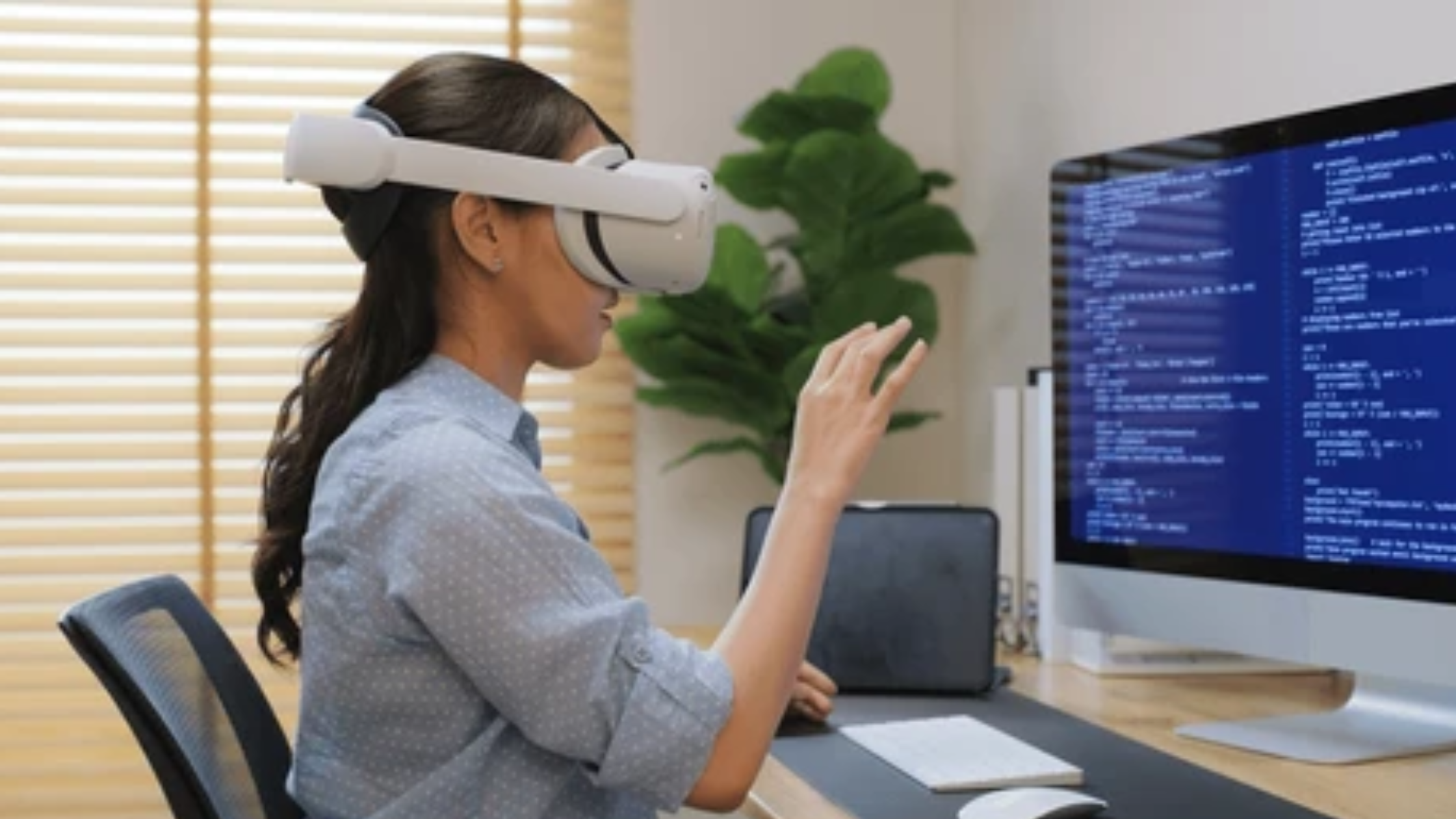
AI makes it possible to create ultra-realistic simulations that immerse employees in real-world scenarios, offering them an immersive and interactive experience. By combining artificial intelligence with virtual reality (VR) and augmented reality (AR), companies are designing dynamic learning environments that closely replicate real-world working conditions. These technologies are particularly strategic for sectors where practice is essential, such as customer service, medicine or even aviation. AI models adapt difficulties and feedback in real time, increasing learner engagement and effectiveness, while making training more immersive and impactful. Take the case of Bank of America, which has implemented an AI simulation training system for its financial advisors. This tool analyzes employee interactions with virtual customers and provides them with instant feedback on objection management, needs analysis and advice personalisation. This initiative made it possible to improve the commercial performance of advisors while strengthening customer satisfaction.
- Development of soft skills
Interpersonal skills, or soft skills such as communication, stress management and leadership, have become essential to thrive in a constantly evolving professional environment. AI plays a vital role in analysing employee interactions in real time and providing tailored recommendations to improve these interpersonal skills. This technology helps refine these skills by offering communication, stress management and emotional intelligence tools tailored to individual needs. At Deloitte, it uses advanced AI integrated into its training programmes to analyse the way its employees express themselves during presentations or strategic meetings. The AI assesses the tone, clarity of the message and stress management, then offers concrete and personalised advice to optimise their impact. This technology has enabled a tangible improvement in employee confidence and a better quality of professional interactions, thus strengthening their ability to convince and inspire in decisive situations.
- Use AI as a personal coach
Advancing in your career today requires more than just accumulating skills; it requires a strategic and personalised approach. AI plays a key role as a personal coach, offering support tailored to each individual by analysing their work habits and providing tailored recommendations. It helps to structure days, optimise priority management and increase efficiency. For example, Microsoft uses Viva Insights to analyse its employees' work pace, suggest strategic breaks, and reduce cognitive overload, thereby improving productivity and well-being. Many companies are adopting these technologies to help their teams develop their skills in a targeted and effective way, ensuring sustainable and relevant professional development.
- Improve your language skills
Mastering a foreign language has become an essential asset in a globalized job market. AI is transforming language learning by offering interactive and personalised solutions. Tools like Duolingo, ChatGPT or DeepL allow you to have dynamic conversations and receive instant corrections to progress efficiently. For example, at Airbus, engineers use AI to improve their technical English by simulating dialogues with international customers and partners, thereby improving their communication and efficiency in collaborative projects.
Case studies

In October 2024, Forvis Mazars initiated an internal programme called the “AI Suite”, aimed at training its 5,000 employees in France in artificial intelligence over a period of 18 months. This programme is divided into three parts: the use of Copilot MS365 from Microsoft to automate office tasks such as document writing and calendar management; the deployment of an internal generative AI called MAIA, designed to analyse large and complex documents, thus providing protected and reliable information; and the integration of these technologies into the solutions offered to clients, in particular by automating the preparation of commented summaries to refine investigations during audit missions. This initiative aims to transform professional practices, increase operational efficiency and improve the quality of services provided to clients.
Sources: www.forvismazars.com
Siemens has collaborated with Infosys to enrich its “My Learning World” platform by integrating generative artificial intelligence technologies. This initiative aims to provide more than 250,000 employees worldwide with a personalised learning experience. Features include an intelligent assistant providing instant responses and tailored recommendations, an AI-powered multilingual content creation tool, a chatbot supporting learners in real-time, and a virtual tutor simplifying content with summaries and translations. Currently, the platform has 216,000 active users with access to more than 178,000 resources, and a customer version, offering more than 300 technical courses, is in development for approximately 50,000 external participants.
Source: www.infosys.com
Shell has initiated a collaboration with Udacity to strengthen the artificial intelligence (AI) skills of its employees. This partnership aims to train more than 200 data scientists and 800 citizen data scientists within the company, enabling them to apply innovative AI techniques in various key activities. Targeted areas include seismic data analysis, predictive maintenance, production optimisation, customer loyalty and electric mobility. This initiative is part of the Shell.ai programme, which already has more than 200 AI projects at different stages of development. By investing in employee training, Shell demonstrates its commitment to integrating AI to improve efficiency and innovation within its operations.
Source: www.udacity.com
Burger King France has adopted the E-TIPI LEARNING platform to manage the training of its employees across more than 500 restaurants. This solution offers decentralized administration, allowing each franchise to create and manage learner accounts independently. The training courses offered are adaptive, adjusting to the specific needs of each employee. The platform also facilitates the automatic generation of administrative documents such as conventions, convocations and certificates of attendance. Thanks to consolidated dashboards, managers can monitor learner progress in real time and analyse the effectiveness of training. This integrated approach ensures effective skills development and optimised management of human resources within the company.
Source: www.e-tipi.com
Conclusion
The integration of AI into employee training is radically transforming the way companies develop the skills of their employees. By combining personalisation, interactivity and immersion, AI makes it possible to optimise learning and ensure skill development adapted to market needs. Many large companies have already adopted these technologies to boost the performance of their teams. It is time to integrate these solutions into your daily life to remain competitive and ready to meet the challenges of tomorrow.