
My Morocco Observer profiles AI Crafters’ evolution from training to engineering and enterprise AI deployment. The publication highlights CraftOS, control over data and international expansion, placing the company within the wider development of AI technology by Moroccan businesses.
From training to a complete approach to AI deployment
Access to an artificial intelligence model is only one part of business transformation. Organisations must decide which tasks to assign to it, which data it can use and how its results fit into daily work. We bring consulting, training, engineering and software development together to address these questions, from initial priorities to systems that teams use in practice.
Our AI strategy and governance work helps select use cases and establish a roadmap. Artificial intelligence training prepares employees to use tools, assess responses and retain control over decisions. Custom AI engineering addresses integrations, automation and the transition into production. These capabilities support one another throughout a project, rather than ending when a pilot is delivered.
Three cofounders with complementary experience
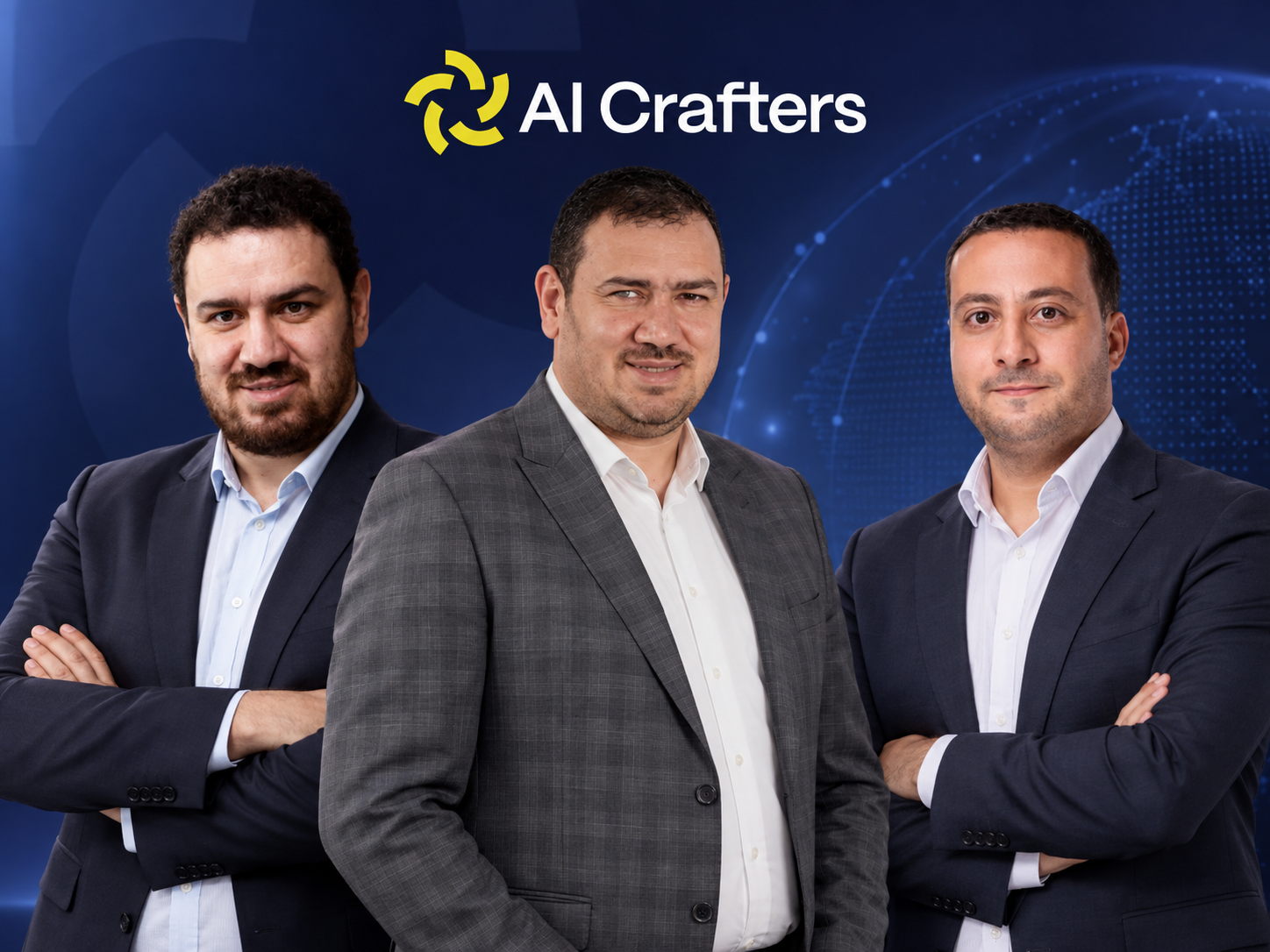
AI Crafters was founded by Zouheir Lakhdissi, Dr Mouhsine Lakhdissi and Morad El Mazyani. Their experience combines organisational transformation, research and data architecture, product design and software development. Together, these perspectives inform how we work: understand the business need, establish the technical foundations and help users adopt the solution.
Our team and company vision explains how consulting, skills development, engineering and proprietary platforms fit together. Consultants, trainers and engineers contribute according to each assignment, working with leadership teams and the people responsible for everyday operations.
CraftOS: a shared foundation for models, data and tools
With CraftOS, the enterprise AI foundation, we develop a platform that connects AI models to enterprise applications and data. Teams use a common environment to access approved models, organise knowledge and configure AI agents. Administrators can define permissions, monitor usage and track consumption by model, team or department.
Connections to existing systems make this foundation useful in practice: Microsoft 365, Google Workspace, Salesforce, ERP systems, databases and internal applications. APIs and MCP connectors support integrations with tools already in place. The scope depends on available versions, access rights and the actions the organisation chooses to permit.
Multiple models and control over deployment choices
Different tasks call for different models. Document retrieval, analysis and summarisation may each have distinct requirements for quality, speed and cost. CraftOS supports a choice of proprietary and open models, depending on the configuration. Organisations can develop their model catalogue as needs change instead of committing every use case to a single technical choice.
Infrastructure matters just as much. Cloud, private cloud, internal servers and CraftOS Box offer deployment options for different operating requirements. For organisations handling sensitive information, data security and governance policies govern access and exchanges. Depending on the rules established, requests can be permitted, anonymised or blocked before transmission.
AI agents and applications that support business work
An AI agent needs a defined mission, relevant knowledge and authorised tools. With CraftOS Agents, the aim is to delegate useful tasks within an identifiable process: prepare a proposal, retrieve information, analyse a document or organise a follow-up. Sensitive steps can require human approval, while action tracking helps teams understand what has happened.
Our suite of AI-native applications extends this approach into business applications. CraftOS CRM brings sales information together and uses WhatsApp AI agents to qualify enquiries and support sales conversations. CraftOS Invoicing combines quotes, invoicing and AI capabilities to simplify administrative follow-up. These products illustrate our approach to AI-native software: connect data, conversations and actions within the team’s working context.
Digitancy: developing skills alongside technology
Announced in April 2026, the majority investment in Digitancy strengthens this integrated approach. Digitancy becomes the group’s training division, while AI Crafters develops its consulting, engineering and deployment activities. Transformation requires suitable tools and the ability of employees to use them within their everyday responsibilities.
Learning programmes should connect directly to business priorities. Leaders need to assess investments and risks; managers need to organise new ways of working; operational teams need to check results and refine their practices. Supporting people is therefore part of deployment from the initial scope through to ongoing use.
Technology designed for businesses across markets
Our ambition is to build solutions that serve organisations in multiple markets. Existing software, working languages, data requirements and team readiness vary. Adapting integrations, policies and deployment allows us to address those differences while retaining a common technological foundation.
Our AI Crafters client stories show this approach in practice through strategy work, automation, AI agents and operational integrations. Building our own platforms also enables us to turn lessons from assignments into reusable capabilities. To explore an initial project or deployment across several teams, talk to us about your AI project.
All news